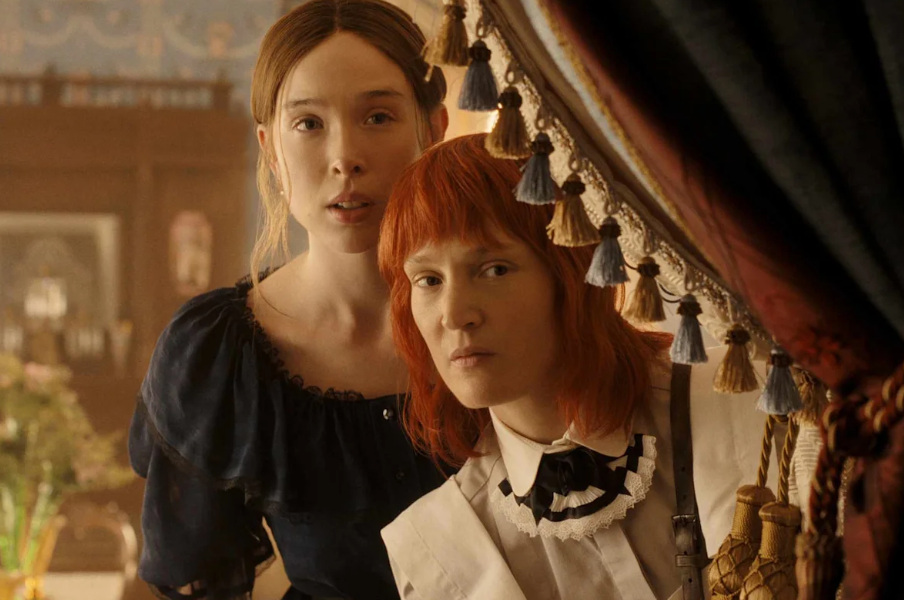
“Monster: The Lizzie Borden Story” (Credit: Netflix)
2013
It was 6 a.m. when I called my friend. We were on our way to the same corporate job, so I knew she'd be up. I’d held in my excitement all night until I spoke with her. I had to tell her about the movie I stayed up to watch, a movie I felt like I should have watched years before, and how it made me feel. Did I mention we were both divorced? No hello, or good morning, just an onslaught of questions and exuberance—
“Why didn’t you tell me about Thelma and Louise?“
“Kim, it's 6 a.m.”
“I watched it last night for the first time! He deserved it! It wasn’t that he was the first man to cross the line, but the accumulation of so many men just like him who thought they could get away with taking our bodies without our permission! As if it’s our duty to give them what they want and to never say no! Like we owe it to them! He wasn’t the first man or even the third man, but I bet you he was the last man!”
“Guurrlll.”
“They drove off a fucking cliff! Together! Hands held in solidarity! They were done! Tired of the bullshit! Tired of playing a game they knew they wouldn’t win! Fuck the patriarchy!”
“Kim…”
“Okay! I’ll see you at work, and we can talk more about it! Is traffic bad this morning?”
“I took the day off.”
“Oh, shit, my bad.”
Click.
___
Sex work is considered the oldest profession: the only job where you never run out of clients— and the demand for newer, fresher, younger supply grows by the minute. But where is the line drawn between a service and a theft— an abuse of “merchandise”? Can a human being be looked at as a product to be sold and disposed of? Sure, as long as the buyer doesn’t see what he or she is buying as human. It’s easier to abuse what you don’t believe is real, what you don’t believe has feelings. What you don’t believe has people who care about them and will wonder where they are if they are missing for a day. People whose lives and existence don’t matter; people you think are disposable.
That’s what I keep thinking about when I look at Aileen Wuornos, a Florida sex worker in the late 80s and early 90s who is widely considered the first female serial killer. From what I know about serial killers, psychopaths, and sociopaths, the statistics largely trend male and white, and their provocations are never self-defense but rather self-gratification stemming from unresolved Oedipal desires and misogyny. Aileen killed in self-defense, as she said, not in the joy of killing, but because a client had taken advantage of her, going against what was agreed upon payment, and treated her as disposable, non-human—trash. I think most of us can relate to Aileen, relate to her feeling of helplessness and fear in the presence of a man who sees you as nothing more than a product to be bought and sold.
No, I’ve never been a sex worker.
But I have been on dates with men who thought that a triple dipper from Chili’s entitled them to me going home with them. I’ve been a wife who couldn’t say no to a husband who didn’t care what I objected to. I’ve been alone with men who couldn’t take no for an answer. If we want to survive, we let him finish. If we want to live, we don’t scream.
I’ve been scared.
I’ve been terrified.
Defenseless—beaten.
I suppose Aileen had become accustomed to taking “it,” had gotten used to being seen as a monster. Until a day came when she thought to herself that she just wasn’t going to take it anymore. And after a while that is what she became—something else, something even unrecognizable to herself—a monster, a bitch, a whore—a murderer.
I always hold my breath a little when I see a new show on Netflix produced by Ryan Murphy and Brad Falchuk. I know that it will, for lack of a better word, disturb me. I know that I won't be able to look away no matter the gore, no matter how real or in my face the truth is— I’m hooked. So, when Netflix announced a new show, “Monster,” the same name as the 2003 biographical movie about Aileen Wuornos starring Charlize Theron, my interest suddenly peaked. I knew that the Murphy/Falchuk duo would do one thing if nothing else— it would consider everyone’s side. I can always count on these guys to show the multifaceted nature of everyone’s point of view. Even if you don’t agree, there is something in you that understands. The “Monster” series showcases other killers, such as Dahmer and the Menendez Brothers, but it’s just not quite the same as Aileen’s case. This “Monster” puts the 1892 story of Lizzie Borden alongside Sarah Paulson on screen as Aileen, pairing the two women in unlikely parallels, whose similarities I admit I’m still trying to find.
This Monster series highlights the 1892 story of Lizzie Borden alongside Aileen on screen, comparing two women separated by more than a century. Lizzie was accused of murdering her father and stepmother with an axe and, despite being acquitted, spent the rest of her life under a cloud of suspicion. Like Aileen, she became something larger than what could be proven about her case: a woman the world still argues over to this day because she sits at the crossroads of female victimhood, rage, and violence.
As soon as I finished the series, my social media timelines exploded with private groups about Aileen and Lizzie. I’m sure they had always been there, but they were now in the forefront, beckoning me to join. And I did.
This online revival of Aileen and Lizzie sang a different tune than the groups I had known in the past. Aileen was a hero amongst women who had been done an injustice and whose voices had been silenced by the judicial systems of a world that didn’t believe them. It was a system that condemned women simply for inhabiting their own bodies. It shifted blame from the men who committed the crimes and placed it squarely on the women who endured them. As though being born female made them inherently guilty, their very existence was treated as an invitation for violation and abuse.
Social media threads argue she was wrongly convicted— these private groups treating her as a woman who was defending herself against rapists and, in return, her life was taken from her. But then there are the other groups, the other side of the opinion pool, where Aileen is no more than a deranged murderer. A misandrist with a score to settle. A prostitute who should’ve known what to expect.
Louise: "I think I fucked up. I think I got us in a situation where we both could get killed. Damn, I don't know why I just didn't go to the police right away."
Thelma: "You know why. You already said."
Louise: "What'd I say again?"
Thelma: "Nobody'd believe us. We'd still get in trouble; we'd still have our lives ruined..."
We know how this scene ends.
What I didn’t think about until now is just how drastic the decision they made was— suicide.
We’d rather die.
What struck me the most as I descended further into the rabbit hole of Facebook groups, Instagram threads, and think pieces wasn’t just how strongly people felt about Aileen but how differently they saw her. The opinion was starkly split. On one side, she was just a serial killer: a violent woman who murdered seven “innocent” men and deserved the title that history gave her. To others, she was a woman whose development was arrested— a prostitute from the age of 14 years old, the daughter of a man sent to prison for the sexual abuse of a child..
How exactly did we expect her to turn out?
___
“And I do have to say one thing, their families must realize that no matter how much they loved the people that died, no matter how much they love them, they were bad people because they were going to hurt me.”
― Aileen Wuornos, “Monster: My True Story”
“I wasn't thinking I WAS crazy. I was thinking these MALES were out of control!”
― Aileen Wuornos, “An Interview with Serial Killer Aileen Wuornos”
___
Here's the part that makes this hard to hold in one hand.
Aileen later took the self-defense claim back. She said she killed in cold blood. She stopped fighting the sentence. She was executed in October 2002.
So the woman some groups are holding up as a hero is a woman who, in the end, didn't hold up that defense herself. And the first killing— the one with the real self-defense argument, the client who broke the deal and turned violent— sits next to six more killings that get murkier the further you go. Seven men.
That's not a detail you get to skip past, and I'm not going to.
But I’m still wondering if she didn’t just say those things because she was ready to die. Imagine having a shitty life, then having to spend the rest of said shitty life behind bars for reasons and causes that weren’t even all your fault. The decisions you made? Just byproducts of a whole lot of people who dropped the ball when it came to loving you. Have you ever been tired of arguing? You know the person you are arguing with will never, and can never ever understand, relate, or empathize with your situation, and on top of that, they have the upper hand in whether you live or die. You think, what’s the point of it all anyways? No one cares enough and no one will ever believe me— so why not just die? Get it all over with. Who wants to fight a fight they can never win?
“There is no point in sparing me. It’s a waste of taxpayers’ money,” serial killer Aileen Wuornos said in July 2001 while seeking to end efforts to spare her from execution.
So what are women cheering for exactly?
I don't think they're cheering for the murders. I think they're cheering for the refusal. For a woman who got to a point where she said: I'm not taking it anymore. Not one more time. Not from one more man who thinks my body is something he bought.
That's the part I recognize. Not the murder— the moment before it. The moment a woman decides she's done being disposable.
And that's why the hero-making says more about right now than it does about her. We live in a moment where women are being told, out loud, that their bodies aren't theirs. Where the law reaches into places it has no business reaching. Where "no" keeps getting treated like the start of a negotiation. So of course, there's a group of 18,000 people online holding up a woman who said no with a gun. Of course there is. When every other door is closed, people reach for whatever's left.
The women who choose the bear are choosing Aileen Wuornos. Not because they want to kill anyone. Because the bear, at least, is honest about what it is. It doesn't pretend it bought you. It doesn't smile and tell you it's your duty. It doesn't ask you to be polite about being hurt.
I keep coming back to that scene. "We'd rather die." Louise says it like it's a fact, not a choice. And that's the thing nobody wants to say out loud about this story: the women in it don't win. Thelma and Louise drive off a cliff. Aileen gets executed. Lizzie Borden gets acquitted and spends the rest of her life locked out of her own town. There is no version of this story where the woman walks away clean.
So maybe the question isn't whether Aileen Wuornos was a hero or a monster. Maybe the question is why so many of us need her to be one or the other— and what it says about the world we're living in that a woman who killed seven men feels, to so many women, like the only one who fought back.